

What is Antiscorching Agent
Antiscorching Agent is an additive mainly used to prevent rubber or other polymer materials from scorching during processing. Scorch refers to the phenomenon of molecular chains breaking due to factors such as heat and mechanical shearing during rubber processing. The main function of the anti-scorch agent is to delay the vulcanization process of the rubber, making the rubber less prone to scorch during processing, thus improving the quality and stability of the product.
Advantages of Antiscorching Agent
Enhanced Physical Properties
Vulcanizing agents help to enhance the physical properties of rubber. During vulcanization, the vulcanizing agent promotes the formation of cross-links between the polymer chains in the rubber. These cross-links create a three-dimensional network that gives the rubber increased tensile strength, elasticity, and resistance to swelling by oils and gasoline. As a result, vulcanized rubber products are stronger, more durable, and longer-lasting than their non-vulcanized counterparts.
Improved Processing
Vulcanizing agents can also improve the processing characteristics of rubber. They can help to reduce the viscosity of the rubber mixture, making it easier to mix and mold. This can result in more efficient production processes, faster cycle times, and reduced production costs.
Customizable Properties
Vulcanizing agents can be tailored to achieve specific properties in the final rubber product. Different types of vulcanizing agents can be used to adjust the level of cross-linking and the resulting properties of the vulcanized rubber. This allows manufacturers to create customized rubber products with unique characteristics that meet the specific needs of their applications.
Wide Range of Applications
Vulcanizing agents are used in a wide range of applications, including tires, hoses, seals, gaskets, and other rubber products. The enhanced properties of vulcanized rubber make it suitable for applications where durability, elasticity, and resistance to chemicals are important.
Compatibility with Other Additives
Vulcanizing agents can be used in combination with other additives to achieve additional properties in the vulcanized rubber. For example, they can be used along with fillers, plasticizers, and antioxidants to modify the performance characteristics of the rubber and enhance its overall quality.
Cost-Effective Solution
Vulcanizing agents are generally cost-effective solutions for improving the properties of rubber. The cost of vulcanizing agents is typically lower than that of alternative methods for improving the properties of rubber. Furthermore, the enhanced durability and longevity of vulcanized rubber products can offset any additional costs associated with the use of vulcanizing agents.
-

Silane Si69
Chemical Name:. Silane Coupling Agent. Molecular Formula: C18H42O6Si2S4. Gravity: 1.08-1.09. CAS Add to Inquiry -
Anti-Reversion Agent KA9188
Product Name: KA9188. Molecular Formula: C36H40N2S6. Molecular Weight: 693.11. Appearance: White Add to Inquiry -
Polyester Dipped Soft Cord
Chemical Name Polyester Dipped Soft Cord Specification Produce features High strength, tensile Add to Inquiry -
Silane Coupling Agent Si69
Chemical Name:. Silane Coupling Agent. Molecular Formula: C18H42O6Si2S4. Gravity: 1.08-1.09. CAS Add to Inquiry -
Antiscorching Agent Silica 7631-86-9
Chemical Name: Silica. Molecular Formula: SiO2·nH2O. CAS NO.: 7631-86-9. Package: 25kg/bag. Add to Inquiry -
Antiscorching Agent Silica
Chemical Name: Silica. Molecular Formula: SiO2·nH2O. CAS NO.: 7631-86-9. Package: 25kg/bag. Add to Inquiry -
Antiscorching Silica 7631-86-9
Chemical Name: Silica. Molecular Formula: SiO2·nH2O. CAS NO.: 7631-86-9. Package: 25kg/bag. Add to Inquiry -
Antiscorching Agent PVI 17796-82-6
Chemical Name:. N-Cyclohexylthio Phthalimide. Molecular Formula: C14H15NO2SN. Molecular Weight: Add to Inquiry -
SUNNYJOINT HVA-2(PDM)
Sunnyjoint vulcanizing agent is suitable for general purpose rubber. Suitable for special rubber Add to Inquiry


Why Choose Us
High quality products
We always put customer needs and expectations in the first place, refine on, continuous improvement, to seek every opportunity to do better, to provide customers with their expectations of quality products, to provide customers with the most satisfactory service at anytime.
Professional service
We can accept factory inspection and goods inspection at any time. Technical discussion, research and development of new products, and complete after-sales service.
Quality assurance
In terms of quality assurance, the company strictly follows the standards and norms of the industry quality system. Adopt industry-leading testing equipment to ensure product quality and good reputation.
Rich experience
Has a long-standing reputation in the industry, which makes it stand out from its competitors. With over many years of experience, they have developed the skills necessary to meet their clients' needs.
Competitive prices
We offer our products at competitive prices, making them affordable for our customers. We believe that high-quality products should not come at a premium, and we strive to make our products accessible to all.
Professional team
We have a team of skilled and experienced professionals who are well-versed in the latest technology and industry standards. Our team is dedicated to ensuring that our customers get the best service and support possible.
What Is the Chemical Composition of Antiscorching Agents
Diethylthiourea (DETU)
DETU is an organic compound that contains sulfur and nitrogen atoms. Its chemical formula is (C2H5)2NS. DETU is a primary accelerator, meaning that it promotes the initial stages of vulcanization.
Thiuram disulfides
Thiuram disulfides, such as tetramethylthiuram disulfide (TMTD), contain sulfur atoms that can form cross-links with the rubber polymer chains. TMTD has the chemical formula [(CH3)2NC6H4S2]2.
Sulfenamides
Sulfenamides, such as N-cyclohexyl-2-benzothiazolesulfenamide (CBS), are organic compounds that contain sulfur and nitrogen atoms. CBS has the chemical formula C13H14N2S2. Sulfenamides are secondary accelerators that are used to enhance the action of primary accelerators.
Guanylureas
Guanylureas, such as diphenylguanylurea (DPU), contain both sulfur and nitrogen atoms in their chemical structure. DPU has the chemical formula C14H12N6S2. Guanylureas are also secondary accelerators that can improve the performance of primary accelerators.
Thiazoles
Thiazoles, such as 2-mercaptobenzothiazole (MBT), contain sulfur and nitrogen atoms in their chemical structure. MBT has the chemical formula C7H5NS. Thiazoles are used as both primary and secondary accelerators.
What Are the Different Types of Antiscorching Agents Available in the Market
Primary Accelerators
Primary accelerators are used to promote the initial stages of vulcanization. They have a relatively fast reaction rate and are typically used in combination with secondary accelerators to achieve the desired level of cross-linking. Examples of primary accelerators include thiourea, diethylthiourea (DETU), and ethylene thiourea (ETU).
Secondary Accelerators
Secondary accelerators are used to enhance the action of primary accelerators and to fine-tune the vulcanization process. They have a slower reaction rate than primary accelerators and are typically used in combination with them to achieve the desired level of cross-linking. Examples of secondary accelerators include sulfenamides, thiazoles, and guanylureas.
Retarders
Retarders are used to slow down the vulcanization process and prevent premature scorching. They are typically used in applications where the vulcanization process needs to be carefully controlled, such as in the production of thin or complex rubber parts. Examples of retarders include zinc oxide and stearic acid.
Activators
Activators are used to enhance the effectiveness of accelerators and to improve the overall performance of the vulcanized rubber. They can help to reduce the amount of accelerator needed and improve the efficiency of the vulcanization process. Examples of activators include metal oxide activators, such as zinc oxide and magnesium oxide, and sulfur-based activators.
Specialty Accelerators
Specialty accelerators are designed for specific applications and can offer unique properties that are not available with other types of accelerators. Examples of specialty accelerators include ultra-accelerators, which are designed to achieve very high levels of cross-linking, and non-sulfur accelerators, which do not contain sulfur and are used in applications where sulfur-free vulcanization is required.
How Are Antiscorching Agents Selected for a Particular Rubber Compound
Rubber Type
Different types of rubber require different types of accelerators. For instance, natural rubber (NR), styrene-butadiene rubber (SBR), and butyl rubber (IIR) have varying chemical structures that necessitate different reaction conditions and thus different classes of accelerators.
Desired Vulcanization Profile
The desired rate and extent of vulcanization will influence the choice of antiscorching agents. Faster vulcanizing compounds may require more reactive accelerators, while slower vulcanizing compounds may require retarding agents.
Processing Conditions
The method of rubber compounding, the temperature profile during mixing, and the type of machinery used will also affect the selection of antiscorching agents. Agents that are compatible with specific processing conditions will be chosen to ensure efficient vulcanization and to prevent premature cross-linking.
Final Product Requirements
The properties required in the final vulcanized product, such as tensile strength, elongation at break, and heat resistance, will guide the choice of antiscorching agents. Some agents may be chosen for their ability to enhance specific properties.
Cost and Availability
Economic considerations also play a role in selecting antiscorching agents. Cost-effective agents that provide the necessary vulcanization characteristics without significantly increasing production costs are preferred.
Environmental Considerations
In recent years, there has been a push towards more environmentally friendly production methods and materials. This has led to the development of sulfur-free and low-sulfur alternatives to traditional accelerators.
Regulatory Compliance
Certain countries or regions may have regulations in place that restrict the use of certain types of accelerators due to health or environmental concerns.
Compatibility with Other Ingredients
The selected antiscorching agent must be compatible with the other ingredients in the rubber compound, such as fillers, plasticizers, and antioxidants.
How Are Antiscorching Agents Typically Formulated into Rubber Compounds
01/
Raw Material Blending
The antiscorching agent is blended with other raw materials such as rubber, fillers, plasticizers, and other additives in specific proportions. The blend is usually carried out in a heated mixer, such as a Banbury mixer or a rubber open mill mixer, to ensure thorough and uniform distribution of the ingredients.
02/
Shear and Heat Application
The mixer applies shear and heat to the raw material blend. This causes the rubber to soften and the ingredients to mix together. The heat helps to activate the antiscorching agent and prepares it for the vulcanization process.
03/
Compound Adjustment
The mixture is often adjusted for optimal viscosity, which is critical for proper extrusion and molding. The mixer operator will monitor the mixture's temperature and viscosity to ensure it meets the requirements for the subsequent shaping and vulcanization steps.
04/
Prevention of Premature Cross-Linking
The compounding process must be carefully managed to prevent the rubber from cross-linking prematurely. This can be achieved by maintaining proper temperature control throughout the compounding stage and using appropriate antiscorching agents that prevent premature vulcanization.
05/
Extrusion or Molding
Once the rubber compound containing the antiscorching agent is properly formulated, it can be extruded into shapes or molded into various forms before undergoing the vulcanization process. During vulcanization, the rubber compound is exposed to heat and sulfur (or other curatives) to create permanent cross-links between the polymer chains, resulting in the final vulcanized product.
06/
Quality Control Testing
Before and after vulcanization, samples are tested to verify that the antiscorching agent has performed correctly and that the final product meets the desired specifications.
How Do the Performance Characteristics of Different Antiscorching Agents Compare
Sulfur-based Antiscorching Agents
Sulfur and its derivatives have long been used as antiscorching agents due to their effectiveness in preventing premature vulcanization. They are typically used in combination with other accelerators and have the advantage of being relatively inexpensive and compatible with a wide range of rubber types. However, sulfur-based agents can contribute to the formation of volatile byproducts during processing, which can pose environmental and health risks.
Thiourea-based Antiscorching Agents
Thiourea and its derivatives, such as thiurams and tetrasulfamides, are known for their excellent antiscorching properties, particularly in sulfur-vulcanized systems. They provide good control over the curing process and can enhance the final physical properties of the vulcanized rubber. However, thiourea-based agents can have limited compatibility with certain additives and may require careful handling due to their potential for skin irritation.
Phosphorous-based Antiscorching Agents
Phosphorous-based compounds, including phosphites and phosphonites, offer effective antiscorching performance in a variety of rubber systems. They are known for their broad compatibility and ability to prevent heat buildup during compounding. Phosphorous-based agents generally have lower toxicity compared to sulfur-based agents and can provide additional benefits such as antioxidation and flame retardance. However, they may be more expensive than traditional sulfur-based alternatives.
Amino-based Antiscorching Agents
Amino-based compounds, such as amines and diamines, are effective in preventing premature vulcanization, especially in high-temperature processing environments. They offer good thermal stability and can improve the processability of rubber compounds. Amino-based agents may require specific curing conditions and may not be compatible with all rubber formulations.
Organotin-based Antiscorching Agents
Organotin compounds, such as dialkyltin salts and mercapto-organotins, are known for their high efficiency in preventing scorch in a variety of rubber systems. They provide excellent control over the curing process and can enhance the mechanical properties of vulcanized rubber. However, organotin-based agents can be more expensive and may have environmental and health concerns associated with their use.
How to Test and Evaluate the Effectiveness of Scorch Inhibitors in Rubber Compounds
Rheological Testing
Rheological tests, such as the oscillatory shear method (e.g., using a rheometer), can be used to measure the scorch time and the optimum cure time of rubber compounds with different scorch inhibitor concentrations. These tests provide data on the compound's viscosity and elasticity as a function of time and temperature, allowing for the evaluation of how effectively the scorch inhibitor prevents premature vulcanization.
Processability Testing
The processability of a rubber compound with a particular scorch inhibitor can be assessed through extrusion, molding, and calendaring tests. These tests simulate the actual manufacturing conditions and allow for the evaluation of how the addition of the scorch inhibitor affects the rubber's flow characteristics, heat buildup, and overall processability.
Mechanical Property Testing
The effectiveness of a scorch inhibitor can also be evaluated by measuring the mechanical properties of the vulcanized rubber, including tensile strength, elongation at break, and hardness. These properties are critical indicators of the quality and performance of the final product, and any negative impact on these properties due to the addition of the scorch inhibitor would indicate a need for further optimization.
Production Trials
Once laboratory tests have identified promising scorch inhibitor candidates, production trials can be carried out to assess the performance of the inhibitors on a larger scale. These trials involve processing the rubber compounds using actual production equipment under real manufacturing conditions to verify the results obtained in the laboratory and to ensure the compatibility of the scorch inhibitor with the production process.
Statistical Analysis
The data obtained from the above tests can be analyzed using statistical methods to evaluate the effectiveness of the scorch inhibitor and to optimize its concentration in the rubber compound. Design of experiments (DOE) techniques can be used to study the interaction between the scorch inhibitor and other formulation variables and to identify the optimal formulation for a given set of performance criteria.
Regulatory Compliance Testing
Depending on the application and the region, the scorch inhibitor must comply with specific regulatory requirements regarding safety and environmental impact. Testing should be conducted to ensure that the selected scorch inhibitor meets the necessary regulatory standards.
How Do You Account for Variations in Raw Materials When Formulating Scorch Retarder for Its Rubber Compounds


Before integrating a raw material into a formulation, it should be thoroughly tested to establish its quality and performance characteristics. This includes tests for chemical composition, particle size distribution, and thermal stability, among others.
Implementing SPC allows for the monitoring and control of raw material variability. By setting upper and lower control limits for critical parameters, manufacturers can quickly identify when raw materials fall outside acceptable ranges and adjust their formulations accordingly.
Developing a formulation that can accommodate variations in raw materials requires flexibility. This might involve formulating with a range of acceptable values for each raw material parameter, rather than relying on a single target value.
Employing robust DOE techniques can help identify the impact of raw material variations on the final product's properties. By varying the raw materials within their expected ranges and observing the effects on the formulation, manufacturers can develop more resilient formulations that are less sensitive to raw material fluctuations.
Adopting a QbD approach ensures that the design of the formulation and the process are based on a deep understanding of the product's critical quality attributes (CQAs) and the relationships among these attributes, the process, and the raw materials.
Maintaining a good relationship with suppliers and regularly communicating about raw material specifications, quality control protocols, and any changes can help ensure that the materials used are consistently within the required specifications.
Regularly reviewing and analyzing production data can reveal patterns and trends in raw material performance. This information can be used to make continuous improvements to the formulation and the process.
Having a contingency plan in place to deal with unexpected changes in raw materials can help minimize disruptions to production and ensure that the quality of the end product is not compromised.
How to Ensure Consistent Performance of Anti-Scorch Agents in Different Batches of Rubber Mixtures
Use high-quality raw materials
The quality of the raw materials used in the rubber mixture can greatly affect the performance of the anti-scorch agent. It is important to use high-quality raw materials that meet industry standards to ensure consistent performance.
Maintain consistent processing conditions
The processing conditions, such as temperature, pressure, and mixing time, can also affect the performance of the anti-scorch agent. It is important to maintain consistent processing conditions across different batches of rubber mixtures to ensure consistent performance.
Conduct thorough testing
Thorough testing of the rubber mixture before and after the addition of the anti-scorch agent can help ensure consistent performance. This can include testing for scorch resistance, viscosity, and other physical properties.
Implement quality control measures
Implementing quality control measures, such as inspection and testing of raw materials, monitoring of processing conditions, and verification of test results, can help ensure consistent performance of anti-scorch agents in different batches of rubber mixtures.
Train and educate employees
Training and educating employees on the proper use and handling of anti-scorch agents and the importance of maintaining consistent processing conditions can help ensure consistent performance.
Our Factory
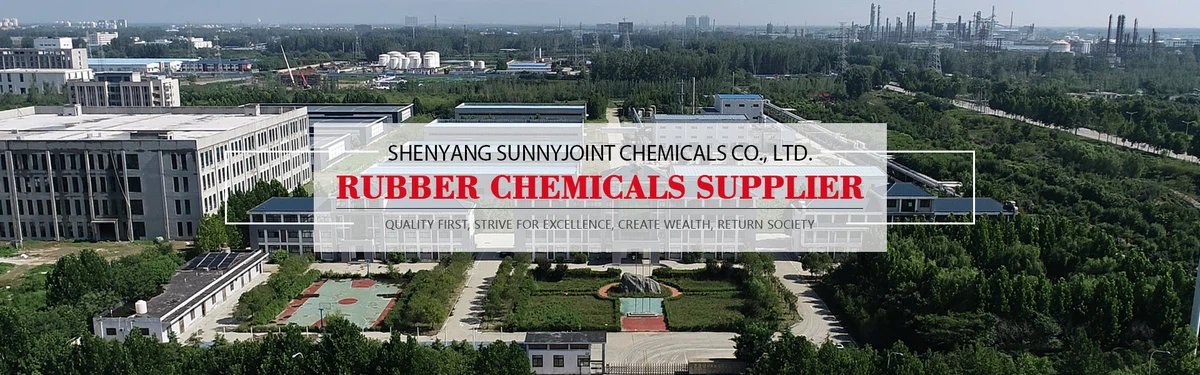
Shenyang Sunnyjoint Chemicals Co., Ltd. is a professional rubber chemicals supplier established in 2003, located in Shenyang, Liaoning province. We devote to rubber chemicals' research, development, production, and sales. The main serials of our products are rubber accelerator, rubber antioxidant, vulcanizing agent, antiscorching agent and so on.
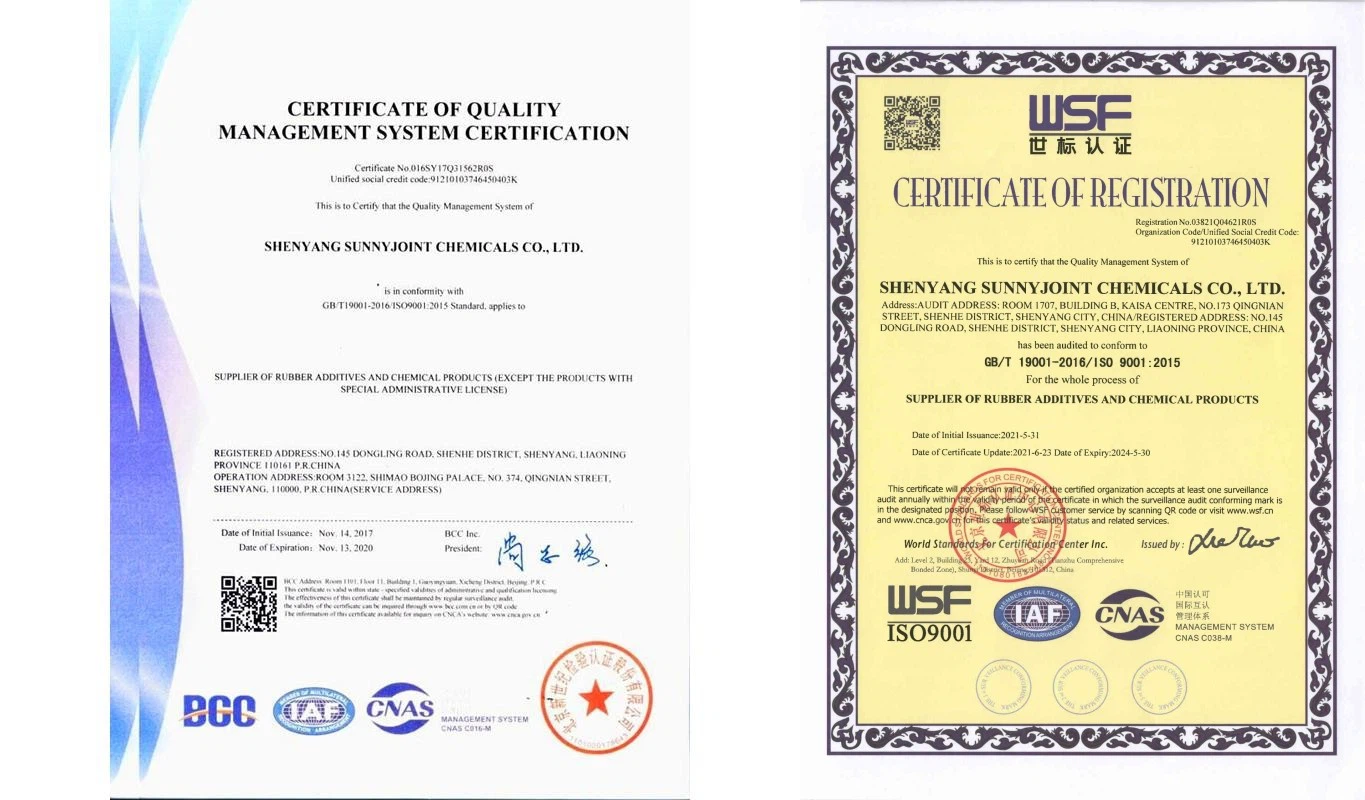
Certifications
FAQ
Q: Can Antiscorching Agents be used for low-temperature applications?
A: Antiscorching Agents are primarily used to prevent scorching at high temperatures. However, they can also provide some scorch protection at lower temperatures, depending on the specific Antiscorching Agent and rubber compound.
Q: Can Antiscorching Agents be used for synthetic rubber?
A: Yes, Antiscorching Agents can be used for synthetic rubber compounds. The selection of the appropriate Antiscorching Agent should consider the specific properties and requirements of the synthetic rubber being used.
Q: Can Antiscorching Agents be used for recycled rubber?
A: Antiscorching Agents can be used in the recycling process of rubber. By adding the appropriate Antiscorching Agent, the recycled rubber can be protected against scorching during processing, allowing it to be reused effectively.
Q: Can Antiscorching Agents improve the processing safety of rubber compounds?
A: Yes, Antiscorching Agents significantly improve the processing safety of rubber compounds by preventing scorching. This allows for easier handling, shaping, and molding of rubber products.
Q: Can Antiscorching Agents affect the physical properties of vulcanized rubber?
A: Antiscorching Agents are designed to prevent scorching during processing and do not significantly affect the physical properties of vulcanized rubber. However, the specific Antiscorching Agent and its concentration may have minor effects on certain properties.
Q: Are there any limitations or disadvantages of using Antiscorching Agents?
A: Some Antiscorching Agents may have limitations or disadvantages, such as potential staining, migration, or interference with other additives. It is important to consider these factors when selecting an Antiscorching Agent for a specific application.
Q: How can the effectiveness of Antiscorching Agents be tested?
A: The effectiveness of Antiscorching Agents can be tested through various methods, including scorch tests, rheological analysis, and analysis of physical properties like tensile strength, elongation, and hardness.
Q: Can Antiscorching Agents be used in non-rubber materials?
A: While Antiscorching Agents are primarily used for rubber, they can also be used in other materials such as plastics and coatings to prevent premature cross-linking during high-temperature processing.
Q: Can Antiscorching Agents be used in combination with flame retardants?
A: Yes, Antiscorching Agents can be used in combination with flame retardants to provide comprehensive protection against scorching and flame spread. This combination is often used in applications where fire resistance is required.
Q: Why is scorching a concern in rubber processing?
A: Scorching refers to the premature vulcanization of rubber compounds, which can occur during processing at high temperatures. It leads to difficulties in shaping and molding rubber products, resulting in defects and reduced quality.
Q: How do Antiscorching Agents work?
A: Antiscorching Agents work by delaying the onset of vulcanization, allowing rubber compounds to be processed at higher temperatures without premature cross-linking. They inhibit the formation of sulfur cross-links until the desired processing temperature is reached.
Q: What are the common types of Antiscorching Agents?
A: Common types of Antiscorching Agents include organic compounds such as amines, thioureas, and thiazoles. Each type has specific properties and applications.
Q: How do amine-based Antiscorching Agents work?
A: Amine-based Antiscorching Agents react with sulfur to form stable complexes, preventing the formation of sulfur cross-links and delaying vulcanization. They are effective at high processing temperatures.
Q: What is the role of thiourea-based Antiscorching Agents?
A: Thiourea-based Antiscorching Agents act as sulfur scavengers, reacting with sulfur to form stable compounds. They effectively delay vulcanization and are commonly used in sulfur-cured rubber compounds.
Q: How do thiazole-based Antiscorching Agents function?
A: Thiazole-based Antiscorching Agents inhibit the formation of sulfur cross-links by reacting with sulfur and forming stable complexes. They are particularly effective in preventing scorching in natural rubber compounds.
Q: Can Antiscorching Agents be used in all types of rubber?
A: Antiscorching Agents can be used in various types of rubber, including natural rubber (NR), styrene-butadiene rubber (SBR), butadiene rubber (BR), and nitrile rubber (NBR), among others.
Q: How are Antiscorching Agents incorporated into rubber compounds?
A: Antiscorching Agents are typically added during the mixing process of rubber compounds. They are evenly dispersed to ensure uniform protection against scorching throughout the material.
Q: Can Antiscorching Agents be used in combination with other additives?
A: Yes, Antiscorching Agents can be used in combination with other additives such as accelerators, Vulcanizing Agents, and processing aids. The compatibility and effectiveness of the combination should be considered.
Q: What factors should be considered when selecting an Antiscorching Agent?
A: When selecting an Antiscorching Agent, factors such as the type of rubber, processing conditions, desired scorch protection level, and compatibility with other additives should be taken into account.
Q: Can Antiscorching Agents be harmful to health?
A: Some Antiscorching Agents, particularly certain amines, can be harmful if not handled properly. It is important to follow safety guidelines and use appropriate protective equipment when working with these substances.
As a professional China antiscorching agent manufacturer and suppliers, we supply rubber chemical, rubber additive and prepared rubber products with high quality and best price. Feel free to buy our quality antiscorching agent.
